


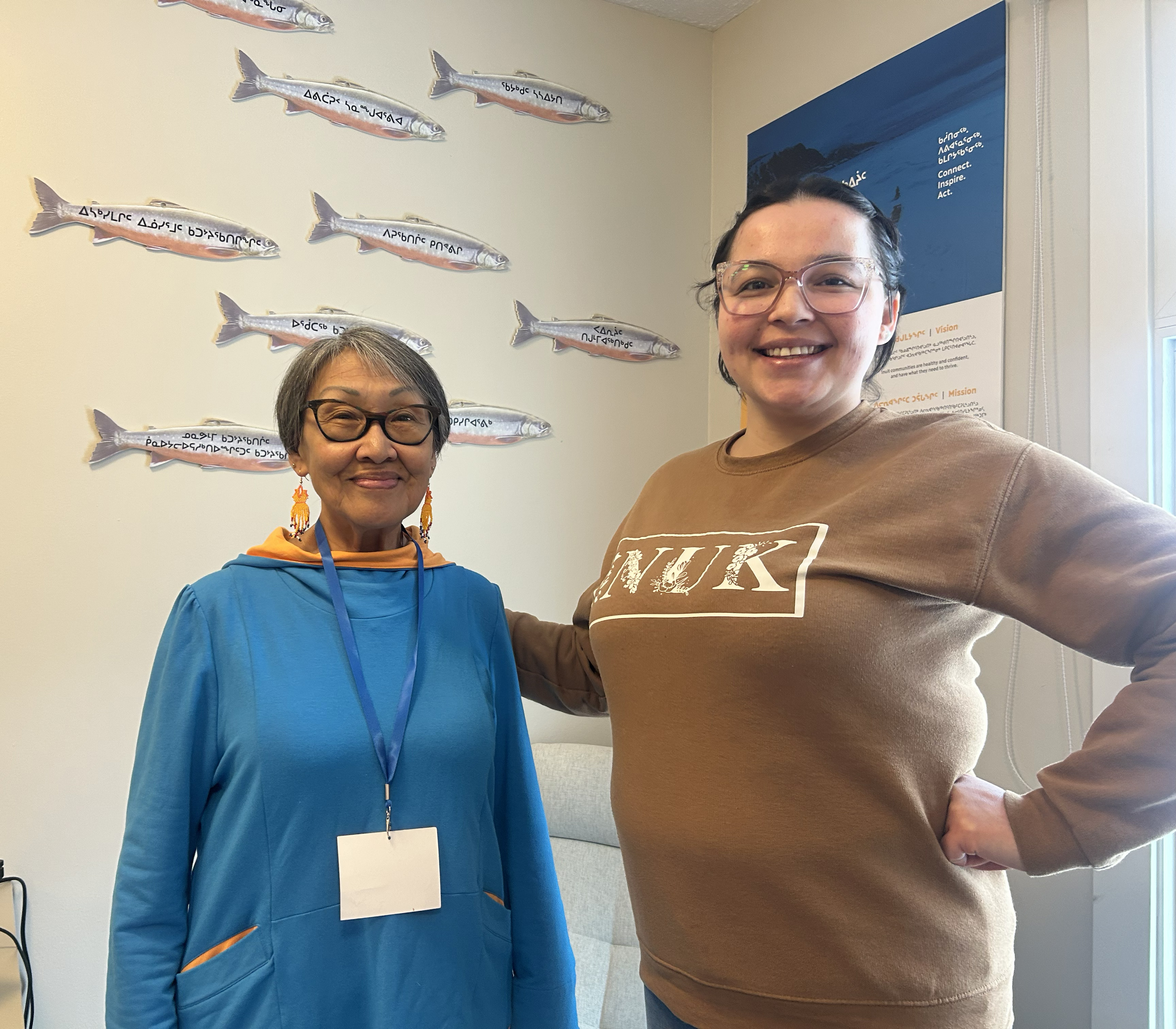
Ahead of our first Free to Play consensus granting cohort, educator, author, and Inuktitut language expert Monica Ittusardjuat sat down with our Community Engagement Lead, Joanne Weedmark, to talk about childhood memories of playing on the land and what's lost when children don't have enough freedom to play.
Monica is Annauma’s technical advisor for Free to Play, a national funding initiative designed to build a movement of outdoor play for children across the country. She is also the author of Making a Whole Person: Traditional Inuit Education and The Scarf and the Butterfly, a graphic memoir about her experiences in residential schools.
Click here to listen to the conversation in Inuktitut.
Note: The conversation below was translated from Inuktitut.
A Conversation with Monica Ittusardjuat
Joanne: What are some of your favourite memories of playing as a child?
Monica: My favourite memory as a child is when my father made me wooden dolls of a mother and child, and my mother would cut out miniature amauti and pants patterns for my dolls. Back then, I was left-handed, and my cousin and I would sew the miniature clothes for our dolls. We had a qarmaq, and we would play a game called "Ua tamanna, aki tamanna." It was a guessing game, and sometimes it would make us dizzy. We had to be really quiet while playing this game, and sometimes it would become a little spooky. It was one of the games I enjoyed playing as a child.
My mother also had a thimble, and I would hide it in different places and have the other children look for it. It couldn’t be behind something or in something because it had to be visible. In the wintertime, you know the Arctic hares are white. We would play at spotting them in the snow. This was a way taught to us so we could learn how to spot Arctic hares in the snow. We played a lot in the snow. We had a qarmaq, and because there was so much snow, the only thing you could see was the smoke coming out from the top of the qarmaq—the smoke from the qulliq. We would shovel around the qarmaq, make trails with steps, and build tunnels where we would play hide-and-seek.
The boys were taught to carve snow blocks into sculptures of polar bears. This was a way to teach them from an early age how to work with snow blocks, so they would have the skills to build an igloo when they were older. They would then pretend to hunt those bears using actual spears.
Joanne: They practiced from a young age so they would be prepared as adults and be ready to hunt.
Monica: They would gain an understanding of the snow, so when they travelled they could build their own igloo out on the land.
Joanne: And they would also learn to be aware of the thickness of the snow, because you can only build an igloo with hard snow, right?
Monica: Snow from close to the ground, because blowing snow forms ice crystals and helps make the snow denser. They were taught how to look for good snow to build an igloo and to pack it with soft snow to help keep the wind from coming into the igloo.
Joanne: As you remember it, were children often free to play outside without much supervision? What kinds of games did they play? For example, were children ice hopping, climbing mountains, or playing games that could be dangerous and aren't allowed these days? Do you recall these activities being played?
Monica: Yes, I recall playing outside. I pretended to have a child, and there were other children who lived in the camp. They would hide my child when I wasn't watching, and I would look for her. When I couldn't find her, I would ask, "Where is my child?" The other children were allowed to respond in any way they wanted, using their imagination. For example, they would say they had sent the child away using frozen Arctic char made into qamutiik, with lemmings as dogs to pull them, and that they had sent the child way over there. We had all kinds of imaginations. We used frozen dog droppings to play. We would throw them, jump, and pick them up again and go to the direction where somebody pointed that’s where they sent my child away. We played all kinds of games using our imaginations.
Yes, in the springtime, when the ice in the bay started breaking up, children were allowed to ice hop, but only with adult supervision. We were not allowed to ice hop without supervision because, if we fell into the water, we might not get the help we needed. There was an exception for the boys, because ice hopping was a way for them to practise. When they were older and out hunting, if the ice broke up, they would have the skills to hop across the broken ice.
The girls would play by the mountains. We would make beds out of rocks, choosing nice rocks to make them look beautiful. We would crush small rocks and pretend they were tea, and the brown crushed rocks we imagined were chocolate. We would also play with mud, molding it into the shapes of qulliit and mugs. We would let them dry and then use them as toys.
Joanne: I'm picturing this. You don't see much of that these days.
Monica: Yes.
Joanne: Back then, if you got hurt while playing in a minor way—like a scraped knee—how would adults react?
Monica: We used lemming skin to wipe our scraped skin and cover the wound with the skin. It was the fastest way to stop the bleeding. My mother would lick the scraped area or a cut, and it would heal quickly. She would also use strands of her hair to sew up a wound, and it would heal quickly.
She used natural remedies back in the day—things from the land, including plants.
Joanne: As you mentioned earlier, a lot of your play as a child involved imagination. What are some examples of those games? For example, playing house, pretending to be animals, and so on. What was your favourite?
Monica: Yes, when bedtime came, we didn't know the English language. We didn't know English words or the alphabet, so we played other games. We would look at the pages of magazines pasted on the wall and say something like, “I spy a hand-pull” for the capital letter “H”, and the hook for the capital letter “J”. The other kids would try to guess where they were. We also played guessing games. For example, I would think in my head, "Mother, father, son, son, daughter. What family do I have in mind?" The guesser would have to guess them in the correct order.
We also pretended to be parents. I would be the mother with children and a husband. The husband would go hunting. We would have pretend dogs with harnesses and pretend whips, and they would leave to go hunting. When they came back, they would tell stories about how the hunt went and whether they had caught a seal. Just like our fathers told stories when they came home from hunting, we copied exactly what our parents did. We also played string games. We played with Arctic hare skulls, bearded seal bones, and caribou bones. We mostly used caribou bones. There would be holes made in the bones, with a string tied to them, and on the other end of the string there was a needle-like bone. The game was to get the needle-like bone into one of the holes.
Another game we imagined involved small shrimp. We would say, "It's coming to you, it's coming to you, it's going to eat you, it's going to eat you—you're done." We also played string games and made many different shapes and figures with the string, such as caribou, Arctic hare, polar bear, and many more. We were taught these so we would become familiar with string, learn to work with it, and exercise our hands in different ways to prepare us for sewing when we were older. We had to remember so many of the figures, and then we passed on and shared our knowledge with the younger children. We used to juggle too, sometimes with three objects. I even learned how to juggle with three.
Joanne: Were you juggling using rocks?
Monica: The rocks were very painful, but yes, we used smaller ones. We also used seal skin to make balls. We would shape the seal skin into a ball, fill it with sand, and sew it closed. It was much softer to use, and that's what we mostly used for juggling. Even adults would play. When they played soccer the teams were formed based on the season you were born in. If you were born in the fall, you were a duck, and that team would try to keep the ball toward the land. If you were born in the winter, you were a ptarmigan, and that team would make sure the ball stayed toward the ice. Sometimes we would play ball all day. We also played wolf. One of us would be chosen as the wolf, and the other players would run toward the another boulder on the other side. When the wolf started running toward us, we had to run as fast as we could back to our “land.” If the wolf touched us before reaching our land, whoever was tagged last became the wolf. It used to be a little scary.
Joanne: I used to play the wolf game as a child. It used to be so much fun.
Monica: These days, we don't see many children playing outside anymore. Children are mostly on their phones. We used to play in tents, run around, and get lots of exercise. That's what we did growing up.
Joanne: After playing outside, you would go home tired because you had used up your energy playing and being active, and you would get a good night's sleep. Now we see children struggling to sleep because they are occupied with their phones. They aren't using up their energy or moving around enough to feel tired.
Monica: We also had bedtime stories. I have one in mind—Kiviuq—but it is a long story.
Joanne: What kinds of games did your children and grandchildren play? Were many of them the same as the games you played? What has changed?
Monica: I still allow them to play traditional games, like the game using the seal bone we call the "dog." It's a guessing game. Back then, when my father was out seal hunting, we would throw the seal bone, and if it landed upright, we knew my father had caught a seal. If it landed at the opposite angle, we knew he hadn't caught one. It was also an elimination game. Instead of predicting seal hunting, we would use the bone to eliminate players. Again, if it landed down instead of up, that player would be eliminated.
What else? I would also tie knots for them to untie, even though some of the knots were quite tight. I also did some sewing with them. I would have them use plastic needles to practise sewing while I was sewing myself. It kept them occupied while also exercising their hands so they could become good writers when they started school.
Joanne: In the South, we hear that children have less free time for play than they used to because they're often in scheduled activities or using devices. Have you also observed that in the North?
Monica: There are lots of moving vehicles now, and there is a chance of children being run over. It's so important to watch the street lights and signs before crossing the street and to always look both ways before crossing. I mean, more so down south. It's important to always stay close to children, although they have a little more freedom around parks.
Joanne: Children need constant supervision by their parents and guardians down south.
Monica: Yes, all the time, because people can be unpredictable. They can be scary, or they may take you, so it's important to keep a close eye on children.
Joanne: Do you see this in the North? For example, children needing constant supervision. In our small communities, our children are often able to play freely on their own because we're basically all family as Inuit in these communities. Do you recognize this in Nunavut, or is it changing?
Monica: It's still important to have supervision, especially for the younger children. Although for older children, it's also important for them to explore on their own. For example, if they have to cross a river and jump across it, they need to be able to do these things on their own, as long as it isn't too dangerous.
They start young here by going on long hikes or walks, like berry picking, freely with other youth. This helps them recognize the skills they have and the skills they still need to develop at an early age. There, there aren't many strict rules about how children should play, and this helps youth become more independent at an early age. If they need to improve a certain skill, they're able to communicate that and ask for guidance or help in learning it.
Joanne: What are some barriers to free play in Nunavut that might not exist in the southern provinces?
Monica: For example, school playgrounds are safe places for children to play. But some places in town, like the area by White Row, can be dangerous. If children are sliding in that area, they could get hurt. It's also important to be cautious of polar bears because they are all over the place now. How is it here with polar bears? I know that in Igloolik they come into town.
Joanne: I am originally from Kinngait, and yes, they do come into town there. Not so much here in Iqaluit, but I do agree. We are seeing more polar bears coming into communities, into the dumps, and right into town.
Monica: Right now, it is more dangerous than before. There are different drugs now, and some criminals are giving them to youth. We need to remind our youth that if a stranger offers them drugs, they have to say no and not take them. How else can I explain it? Youth cannot go boating alone. They always need an adult present. Things like this are important for them to know.
Joanne: What did play look like during periods when it was too cold or too dark to be outside for very long?
Monica: When we were young, during the wintertime, we would play outside for long hours by the hills and cliffs, to the point where our mitts would freeze solid. When I went home, my mother would blow into my frozen mitts and warm up inside my mitts, and I would go back outside and play some more.
Joanne: For example, when a blizzard hits a community, everything shuts down, including the schools, and children are asked to stay indoors. Back in the day, in my time too, we would still play outside. We would slide in the snow, run around, and let the wind blow us around, but you don't see that anymore. Did you ever play outside during blizzards or when it got dark outside?
Monica: It used to be so much fun when they sent us home from school on blizzard days. We would immediately go outside and play hide-and-seek. Sometimes it would take a while for the other children to find each other, and that's what made it fun. Playing outside in a blizzard was always enjoyable. In the dark, not so much, because children didn't like the dark. My children mostly stayed indoors.
Joanne: When you were growing up, did you ever hear stories about the Aqsarniit (Northern Lights)? Do you have a story to share?
Monica: Yes, the one about them playing football with a walrus head. We truly believed they would take our heads off. The men would start whistling to the Northern Lights, and when they whistled, we could even hear the Northern Lights crackle. We would think they were coming after us. Our first thought was, "They're coming to take our heads off."
Joanne: Was it because your parents didn't want you out in the dark? Were you told those stories about the Northern Lights?
Monica: It was a story that everyone knew.
Joanne: Did you believe it?
Monica: Yes. It was a traditional story, but I truly believed it.
Joanne: I believed those stories too. They even used to tell us that if we didn't wear our hats in the wintertime, the Northern Lights would come after us.
Monica: In the fall, we were told not to play with seaweed or kelp and use them as whip; otherwise, it would become windy. That was because you might get sand in your eye. If children are told not to do something, they do it anyway, but telling them that whipping with a kelp would cause it to become windy. What else? We were taught not to do certain things because everything has consequences. We were also told not to throw sand into the air; otherwise, it would start raining, or the sand could get into your eyes. These were some of the things we were taught while growing up.
Joanne: What do you think children are missing out on if they don't have as much time to play freely? As you mentioned earlier, it's important to start exercising young children's muscles and developing the body as a whole, especially at an early age.
Monica: How can I explain this? Back then, if we didn't have a sled, we would use seal skins and help make the seal skins smooth and shiny. Sliding on them was always fun, but the toughest part was walking back up the hill, which gave us good exercise. Now, schools have gym classes, but at home there isn't much encouragement for children to be active. Many children are either watching movies on TV or playing on their phones, which results in very little movement. If they were outside instead, they would be using their energy and exercising.
Joanne: Their bodies would be much stronger, right?
Monica: Yes. Exercising their muscles and moving their bodies is important. The only way children are going to learn and become independent is if they get out there and play. We played a lot of tag growing up. Even when we were riding the qimuksiq (dogsled), other dogsledders would play tag with us while travelling by dogsled. It involved a lot of running.
Joanne: Did you also play Inuit games outdoors, such as leg wrestling, muskox fights, or other competitive games like pilliqtaq, while you were growing up?
Monica: Yes, I'm forgetting some of the names. What is that one called?
Joanne: Sittuqtaq?
Monica: Sittuqtaq, yes—sittuqtaq, pigliqtaq, and hand-pulling with two sticks tied with a rope. Back then, one person would hold the stick and the other person would hold the other stick and they pulled to determine which one was stronger. We played these games in qarmaqs. We also did handstands and all kinds of Inuit games. It used to be really fun, and the adults and Elders really enjoyed watching us. They encouraged us to exercise in these ways.
Joanne: You don't see many of these activities anymore.
Monica: They're very simple and easy to organize.
Joanne: And you don't have to spend any money or buy things from the store. You don't need special materials to play these fun games.
Monica: Very true.
Joanne: As Inuit, we find ways to play. We don't need lots of resources or materials.
Monica: Yes.
Joanne: We work with what we have—bones, rocks, and other things—and become creative, finding different ways to play.
Monica: Yes. What else? We also used to play a game where many children sat in a circle, and one person would stand in the middle, stiff like igunaq. We would gently push the person toward the other participants using our arms, passing them around the circle while making sure the person didn't fall to the ground. Apparently, it was a way of getting our arms moving and exercising our muscles. It used to be really fun.
Joanne: This is going to be my last question. What are some ways people and organizations in Nunavut could make it easier for children to play freely?
Monica: Yes. In Igloolik, during the Christmas holidays, one of the traditional games I mentioned earlier was "Qiturngarjuapigali nauk?" ("Where is my child?"). That's when I remembered that this was one of the games I played.
The other traditional games too—when they are shared and talked about with community members, we don't forget them. As we've been talking, I started remembering other games as well. Children today don't really know or understand these types of play, so it's important that we talk about them and encourage children to learn and understand them.
Joanne: We need to talk about these games and encourage our families and communities to continue playing them, whether it's with our children, cousins, or by sharing them in schools and daycares. The only way we won't lose them is by continuing to talk about them.
Monica: Very much so. We could also have Elders filmed talking about these different types of traditional games. Children can learn by watching them, and that's one of the best ways they are going to learn—by watching and listening.

.jpg)
.jpg)